Build, train and deploy physics-aware models from engineering data. Solver-agnostic. Physics-consistent. Validated.
Engineers should spend less time configuring solvers and more time exploring solutions. The bottleneck in mechanical engineering was never the physics — it was the friction around it.
By combining simulation, machine learning and physical constraints, we enable a new generation of engineering systems: ones that learn the governing laws, respect them, and explain their answers.
Ingest geometry, materials, boundary conditions and sparse sensor data.
Physics-informed models trained under known constraints.
Validated fields, stresses, reaction forces — with a report.
Traditional CAE demands deep specialist knowledge, heavy manual setup, expensive licences and long waits before a trustworthy result. Every iteration means re-meshing and re-configuring solvers.
Agnostix proposes an AI-native layer that lowers the barrier: engineering intent goes in, structured simulation comes out — validated, reproducible and explainable.
// Legacy CAE: expert → setup → mesh → solve → re-mesh → repeat.
// Agnostix: intent → model → validated result.
The visual editor — the Figma of engineering. CAD, geometry, materials and boundary conditions in; model, study and training job out.
The computational core. Solver-agnostic by design.
A public library of reproduced papers, benchmarks and scientific datasets — every method validated in the open.
Describe a problem in natural language. Receive a structured, executable study.
A marketplace for reusable models, datasets and engineering workflows.
Inference at the edge and in the cloud. Digital twins in the loop.
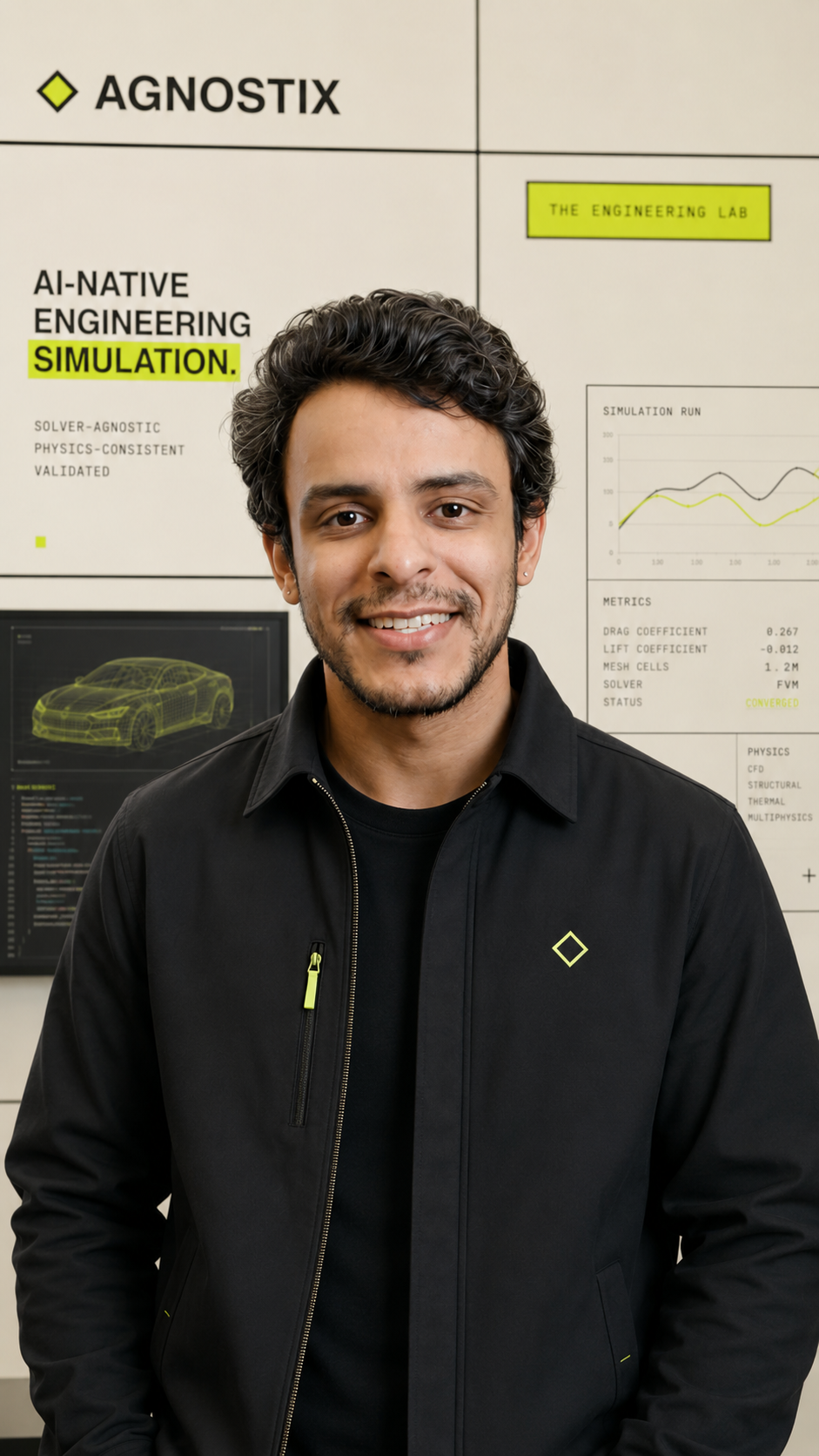
[ Founder · The Lab ]
// We are onboarding research labs and R&D teams in waves. Drop your email for early access.